Sunday, February 27, 2022

God Calls Us To A Holy Salvation! #JesusFollowers

"Good Teacher, what good thing shall I do, that I might have eternal life?” (Mark 19:16)

Suppose I was speaking with an immoral person who had heard of Jesus, but believed him to be an impostor. I might attempt to convert him by rational argument and by Jesus’ Gospel.

I first convince him of the existence of one infinite Creator, Governor and Father. You perceive that he would then be saved from his ignorance concerning the nature of the Supreme Being.

I next convince him that Jesus of Nazareth is the divinely commissioned Savior of the world. You perceive that he would then be saved from unbelief.

I further convince him that if he would be a true Christian, he must obey the instructions, imitate the example and soak in the spirit of the great author of our faith.

When his actions give evidence of a reformation of heart and life, we can perceive that he would be saved from his iniquities; as well as blessed with a righteous and holy character.

So, Christian salvation consists in deliverance from ignorance, and sin, and in the possession of Christian knowledge, virtue and piety. This salvation takes place whenever a person becomes a practical Christian. And Divine pardon can be obtained only by forming a Christian character.

Jesus became the author of eternal salvation unto all them that obey him. We can obtain the divine pardon only by forming a Christian character.

Reason teaches us that our heavenly Father is our supreme Savior, the original author of our lives, and all things in existence. And for what purpose has He given us being? Solely for our own good; because He is infinite love.

If love prompted Him to create intelligent offspring, that same affection must dispose him to regard them with tenderness, and to be their eternal Benefactor.

Our heavenly Father has commissioned Jesus of Nazareth to be the Savior of all who would come unto him and qualified him for the successful execution of his divine office. These truths are plainly taught in various parts of the Scri xxptures.

The whole process of salvation is perfectly plain and intelligible. Jesus exerts no mysterious influence over us.

So far as he induces us to become good, he is instrumental in our salvation, and no farther; for we are not saved, and we shall never be saved, unless we become holy.

This is expressly declared by our Savior himself. ”Not every one that says unto me, ‘Lord, Lord,’ shall enter into the Kingdom of Heaven, but the one who does the will of my Father who is in Heaven.”

Those who continue in disobedience are not partakers of his salvation.

Our heavenly Father saves us by leading his intelligent children to consideration and obedience. This is clearly taught in various passages of scripture.

Our interest, our duty, and our happiness coincide. Let no one then be so simple as to think he shall be always sure of happiness, without personal holiness.

For unless he faithfully improves all his talents, they will hereafter swell the fountain of his misery.

Unless your talents serve to wean your affections away from earthly vanities; unless they raise your thoughts to the unseen realities of eternity; unless they lead you to self-scrutiny, self-discipline and self-cultivation, they cannot promote your Christian salvation. For this instrument will save you only so far as it makes you holy, and no farther.

The great majority in civilized lands profess to believe in the Christian religion. Only a part are influenced by their faith to conform to its requisitions.

The remainder act in direct opposition to their profession, because their belief is merely speculative.

The substance of the whole matter, therefore, is this. Only so far as a person obeys Jesus, only so far will he bring forth good works; and only so far as he exhibits those good works, only so far is a person justified by all its exercises.

So, speedily reform whatever you discover amiss in your heart or lives. Quickly supply whatever you find defective in your faith or practice. Confirm and strengthen whatever you possess according to truth and godliness.

And never imagine that you have arrived at perfection; but forgetting your past mistakes, pressing forward most zealously to higher and still higher degrees of Christian knowledge and holiness.

Your Father remembers that you are dust, and he does not require impossibilities of his children.

Place the perfect example of your divine Master ever before you.

He came not to make us happy in our iniquities. This he could not do. This God himself will not do. He must first aid us in becoming good, before we can possibly be happy.

(Abridged and adapted from an 1831 sermon by Rev. Bernard Whitman)

Sunday, February 20, 2022

The Mission of Jesus: To Bring Division


"I came to cast fire on the earth, and would that it were already kindled! I have a baptism to be baptized with, and how great is my distress until it is accomplished! Do you think that I have come to give peace on earth? No, I tell you, but rather division. For from now on in one house there will be five divided, three against two and two against three. They will be divided, father against son and son against father, mother against daughter and daughter against mother, mother-in-law against her daughter-in-law and daughter-in-law against mother-in-law." (Luke 12:49-53)

"Can’t we all just get along?" That was the famous refrain of Rodney King, whose beating by Los Angeles Police officers sparked rioting in 1992.

It’s also the refrain of many who would prefer not to have any controversy or difficulty in their lives, and who hate controversy and conflict, and wish to avoid it at all costs – even at the cost of believing something wrong.

After all, who wants to rock the boat when the water’s not choppy to begin with? Those who question – especially in Christendom’s churches – are seen as troublemakers and malcontents. "Why do they have to raise questions?" they're asked. "Why don't you keep your head down and stay out of trouble?"

It’s the same question Jesus was probably asked. But Jesus came to question, to cause division, and spark controversy. It was only in that way that he would “spark a fire”  that would usher in God’s Kingdom.

Jesus could have become a very popular Pharisee, had he not challenged them and their practices at every opportunity. But instead, Jesus boldly and repeatedly questioned why they were hypocritical in their approach to scripture and religious practices.

He asked why they invented rituals like washing hands and saying prayers that no scripture taught. He vigorously challenged those who were profiting in God’s temple. He questioned those who strung together long, self-centered prayers in public in order to be seen as pious. And he would not tolerate those who wanted to simply sit on the sidelines and not take sides while people compromised their ethics and values, rather than putting them to WORK.

And today, if we follow Jesus and his model, we must look at our religious authorities and again  raise questions, spark controversy, and create division – even if the questions are uncomfortable.

In many Christian churches, the water is indeed smooth as glass when it comes to doctrine, but like in Jesus’ time, the waters need churning, because even most “Protestant” churches unquestioningly accept the Roman Catholic Doctrines supposedly “settled” back in the Fourth and Fifth Centuries, or earlier.

But a doctrine that has been believed for a long time by many people isn't "truth," it's just a long-held, popular belief.

Is Peace-at-any Cost worth it, if we violate our principles? Are we truly following Jesus if we accept man-made doctrines and practices without questioning them, as Jesus did?

Jesus overturned the tables in the temple from which people were profiting from God rather than serving God in humility. Should we remain silent when a “Religion Industry” rakes in hundreds of billions in cash, often preying on the elderly and vulnerable or promising riches and health in exchange for cash?

Jesus taught us to avoid long prayers, or praying for "stuff" like Pagans did, because God knew what we already needed – spiritual treasure that lasted for eternity, not material treasure that rotted and rusted. Should we not challenge with all of our might a false "Gospel of Prosperity" that implies that God will make us rich if we say the right magic words and that we can manipulate Him into giving us material wealth?

Jesus taught us to avoid practices and rituals that had no basis in the Hebrew Scriptures. Should we turn a blind eye to those doctrines taught just because traditionally, they were believed, even if Jesus would not recognize them, or find them actually blasphemous?

Jesus taught us to serve the poor, comfort the widow and others who are afflicted, and to feed and clothe the hungry and naked. Should we pretend that was for another age, and that “works” aren't REALLY required of us, because we have supposedly demanded and obtained the "prize" of eternity from God?

These questions today will create discussion, division and yes, controversy. Isn't that what Jesus requires us to do if we come and follow him? Or are we to put our heads down and remain silent, as Jesus himself refused to do?

Sometimes, long-held doctrines and practices of men must be challenged, and just because they've been unquestioned for a long time and have a lot of clever defense (dreamed up over hundreds of years, repeated by many clever men) doesn't mean that they are correct. Just because Goliath has intimidated others for a long time, so that no one would question him, doesn't mean he must never be confronted by a David.

We must not transgress the commandments of God in order to follow the traditions of men. We are called to challenge doctrines and dogmas despite their seeming age and solidity, and seriously question them, because Jesus is our Master, and his model is the one we must follow.

Sunday, February 13, 2022

What Is Love? #JesusFollowers

"Love" is one of those words in the English language that can leave us easily confused.

As we prepare to celebrate Valentine's Day tomorrow, let's examine the various ways in which this word is being used in contemporary society, and how Jesus used the word.

Love can mean a strong attachment to pancakes or pickles, a deep emotional attachment to another person like a spouse, parent or neighbor, it can express a deep “fan” relationship with a movie franchise like Star Wars, or it can mean lust for a drug, a person, an object, or a stranger.

This imprecise definition didn’t exist in the oldest manuscripts of the words of our Master, Jesus, which were preserved in Greek. 

Love most often was conveyed in the Gospel books with a word, agape [agapaō] which means a pure, all-consuming love. 

It’s this word that is used when Jesus calls us to, "Love Yahweh, your God, with all your heart, with all your soul, and with all your mind." And, "Love your neighbor as yourself."

It was not limited to our friends, or to those who love us, because it’s agape that is used when Jesus says “Love your enemies.” (Matt. 5:43)

The Fourth Gospel records, “For God so loved the world,” using that same word, agape, showing that God has deep, abiding and unlimited love for us. God chose and sent out Jesus as our special example to us, so that we might not live in darkness, but in light.

But it’s not just God than can show this love, however. We are called by Jesus to “Love one another; JUST as I have loved you, you also are to love one another.” (John 13:34)

The fact that we are to love “JUST AS I HAVE LOVED YOU” is a powerful calling to us. We are told by Jesus that we may indeed love just as he loved; act just as he acted; serve just as he served. Our love is to have no bounds, just as Jesus’ love had no bounds.

This is all important to understand, given the many misconceptions about “love” – even among those who attend the churches of Christendom today – and even among those who do not.

"Love" having so many meanings, many today believe the love we are called to show is the shallow love we have for food, movies and other things with which we have a strong emotional attachment.

It would be a serious mistake, however, to assume that ALL we must do is express a light, shallow Love towards God and towards others. "Love is All You Need" is the name of an awesome Beatles song about emotional attachment between two lovers, not the imperative that Jesus calls us to embrace.

The Power of Love, the kind of Love that God shows us through His son, Jesus, is the kind of Love that is deep, unattached to emotions. It’s not an erotic love, or a shallow love, or a "love" that has no meaning or caring behind it, but it is instead the deepest and most pure Love there is. 

This kind of Love must be the cornerstone of our faith. Love of God and love of our neighbors is what Jesus calls us to actively show in our daily lives.

The faith that Jesus teaches challenges us to love God so much that we love others just as God does, and show it by doing Good Works in the service of others.

And we are called to love and obey God and serve others, using Jesus' perfect example as our guide, and then we are to accept that GOD ALONE is our judge, and our God is a God of mercy, if we ask for it.

"Whoever has my commandments and keeps them, he it is who loves me." (John 14:21)

"If you keep my commandments," says Jesus, "you will abide in my love, just as I have kept my Father's commandments and abide in his love." (John 15:10)

Sunday, February 6, 2022

The Union of Spirit And Matter In Humanity

Our life exists in a mysterious union of the corporeal and intellectual principles, an alliance of unique intimacy, as well as of strange contrast, between the two extremes of being. 

In their due relation to each other, and in the rightful discharge of their respective functions, I do not know whether the pure ethereal essence itself, (at least as far as we can comprehend it, which is but faintly, ought more to excite our admiration than this most wondrous compound of spirit and matter. 

I do not know that it is extravagant to say, that there is as unique a display of the divine skill in linking those intellectual powers, which are the best image of the Divinity, with the forms and properties of matter, as in the creation of orders of beings purely disembodied and spiritual.

When I contrast the dull and senseless clod of the valley , in its unanimated state, with the curious hand, the glowing cheek, the beaming eye, the discriminating sense which dwells in a thousand nerves, I feel the force of that inspired exclamation, "I am fearfully and wonderfully made!"

And when I consider the action and reaction of soul and body on each other, the impulse given to volition from the senses; and again to the organs by the will when I think how thoughts, - so exalted, that, though they comprehend all else, they cannot comprehend the laws of their own existence - are yet able to take a shape in the material airs issue and travel from one sense in one man to another sense in another man; so that, as the words drop from my lips, the secret chambers of the soul are thrown open , and its invisible ideas made known - I am lost in wonder.

If to this I add the reflection, how the world and its affairs are governed, the face of nature changed, oceans crossed, continents settled, as families of men gathered and kept together for generations, and monuments of power, wisdom, and taste erected, which last for ages after the hands that reared them have turned to dust, and all this by the regency of that fine intellectual principle, which sits modestly concealed behind its veil of clay, and moves its subject organs, I find no words to express my admiration of that union of mind and matter, by which these miracles are wrought by God Almighty.

(Adapted from a speech by Edward Everett, June, 1833)

Sunday, January 30, 2022

Obtaining Wisdom From God #JesusFollowers

"Vanity of vanities, says the preacher, vanity of vanities; all is vanity.” (Ecclesiastes 1:2)

This is recorded as the declaration of one of the wisest, if not the wisest of all the men that recorded history give us an account of: and from what is recorded of him and of his sayings and doings, we have reason to believe that he was so. 

And when he was raised and exalted upon the throne of his father, David, he was humbled, no doubt, under a consideration of his incapacity, at that time, to govern and rule so great a people. 

And having done some work that was grateful to the Almighty, He made him an offer, to ask of him what good he should choose? 

It was not for long life, nor riches, nor honor that he asked, but that the Lord Almighty should endue him with an understanding heart, and wisdom that might qualify him to judge and rule so great a people. 

And his request was granted - the Almighty gave him greater wisdom than any other man; and from the account recorded of his wisdom and acts, it seems verified. 

Now, there is a good deal to be learned from this account of that great and wise king. By looking to this same Source for wisdom and understanding, we shall gain more true knowledge than we were ever able to arrive at through mere human, rational science. 

It is that only which can enable us to fill up our place in creation, agreeably to the design of a great and gracious Creator. 

By attention to the manifestations of God’s will, He will certainly give us this same knowledge, for we must know his commandments, and what he requires of us before we can do them: and therefore He has given to every man and woman a measure of His own Spirit.  

When we repent, and are sincerely sorry for what we have done, He grants us the gift of forgiveness, and we come to experience remission of sins, and reconciliation with our Heavenly Father. 

This is the way in which we can fulfil the first and great commandment, “You shall love the Lord thy God with all thy heart, and with all thy soul, and with all thy mind, and with all thy strength.”  (Matt. 22:37)

We give all up for Him, and for His sake; not only all that is dear to us here on earth, but our own lives. This was shown in the example of our great and blessed pattern, Jesus; who, for the love he bore to the truth and the God of truth, readily surrendered his will and life, to the will and mind of his Heavenly Father - such was his love to him. 

When we come to love God with all our heart, and soul, and mind, and strength, it becomes the most excellent, and beautiful, of all things.

Therefore, as this comes to be our experience, it fixes and impresses upon our minds a care, that every step we take may be conformable to our duty to God, according to His requirements. 

Here, now, when we come to know God, and feel him to be continually with us, an observer of all our works, and watching over us continually for good, it enables us to put in practice the saying of the wise man, “Fear God and keep his commandments, for this is the whole duty of man.” 

And our duty to our Heavenly Father, and our own best interest, can never be divided: they are one, because Almighty Wisdom has ordained that every act of a man's life shall have its consequent reward, let it be good or evil.

(Adapted from a December, 1826 sermon by Quaker lay preacher Elias Hicks)

Sunday, January 23, 2022

The Role of Jesus's Moral Example In Our Salvation #JesusFollowers

That Jesus was a Savior sent from God is a revealed truth, and is thus an essential article of faith. If there be any secret purpose, or mysterious efficacy in his doctrines and actions, they have not been made known, and therefore it is not a necessary part of a Christian's duty to search them out.

That Jesus is a Redeemer, and a Savior, with full power from heaven, is enough for anyone to know, who opens his mind to a ready reception of all the doctrines, which he has plainly taught, and who is determined to obey the precepts, and comply with the conditions of the Gospel.

But the busy curiosity of men has not been satisfied with this simplicity of faith. To believe in mysteries has been found a much easier task, than to do justly, love mercy, and walk humbly; and hence many persons, in their notion of redemption through Christ, have indulged in fancies, which have little to do with the love of God, the religion of the heart, or a preparation for heaven.

John Taylor has some excellent remarks bearing on this point:

“Righteousness, goodness, and obedience, must be of the highest esteem and value with the Father of the universe, a pure and perfect Spirit; the only power, if I may so say, that can prevail with him, and the only acceptable price for purchasing any favors or blessings at his hands.”

This argument is rational, scriptural, and forcible. Place the subject in what position you will, and it must nevertheless be true at last, that a doctrine, which assigns the highest rewards of heaven to the exercise of righteousness and a cultivation of the moral powers, will be eminently fitted to encourage good morals, and quicken the pious affections. This will hold true of the above opinion respecting the way of salvation through Jesus, whether that opinion be an accurate deduction from the sense of Scripture or not.

So far from invalidating, it helps to enforce every moral precept, not only by insisting on a holy life as a necessary preparation for enjoying the benefits of Christ's death, but by maintaining that the power of conferring these benefits has been granted on the same consideration.

The wicked have broken his laws, and by this reason are subject to the penalty of disobedience; nor can they ever be reconciled to his good government, till their minds are renewed, their sins forsaken, and their characters changed. When this is done, a reconciliation will be brought about, not on the part of God, but of men. To produce this reconciliation, that is, to suppress all opposition to the wise and righteous laws of God, was the grand object of the Savior's mission into the world.

God is the author of the whole; and everything in the economy of redemption is to be traced to his love, and not to wrath or vindictiveness, for no such emotions can exist in the divine nature. Not a more imposing truth presents itself in the whole tenor of Scripture, and the whole moral work of creation, than that “God is love.”

The very reason why God sent His Son to be a Redeemer and a Savior is declared to be, that He loved the world. The well-being and happiness of His creatures contribute as much to His glory, as the beauty, order, and perfection of His works.

In what can a holy God delight more, than in beholding the creatures, whom he has formed with high and varied powers, enjoying the felicity, which results from the noblest exercise of these divine gifts, and which exhibits in a brilliant light the power, wisdom, and benignity of their author ?

When they have unwisely forsaken his counsels, and brought misery upon themselves, it does not excite anger in their heavenly Father, but compassion.

Everything done by him which has a tendency to reconcile men to God, constitutes a part of his great work. His instructions, his preaching, his wonderful Sermon on the Mount, his appropriate and beautiful parables, his advice, counsel, warnings, threats, promises, have their respective important effects. That he acted by the aid, and guidance, and power of his Father and our Father, these hold a distinguished place in the work of redemption through Christ, by convincing men of the truth of his doctrines, and strengthening their confidence in the divinity of his character.

The holy and perfect example of Jesus, his piety and humble submission to God, his deeds of goodness and love, his disinterested and unceasing benevolence, his patience in adversity and fortitude under every trial, his invariable uprightness of conduct and excellence of temper, all these are so many incitements to repentance and a good life.

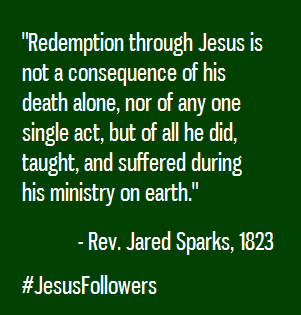
Hence, redemption through Christ Jesus is not a consequence of his death alone, nor of any one single act, but of all he did, taught, and suffered during his ministry on earth.

(Adapted from a sermon by Rev. Jared Sparks, 1823)

Sunday, January 16, 2022

What Is The Church? #JesusFollowers

A Christian church is a body of men and women united together in a common desire of religious excellence, and with a common regard for Jesus of Nazareth, regarding him as the noblest example of morality and religion - as the model, therefore, in this respect, for us.

The action of a Christian church seems to be twofold: first on its own members, and then, through their means, on others out of its pale.

Let a word be said of each. If I were to ask you why you came here today why you have often come to this house hitherto - the serious amongst you would say: That we might become better; more human; upright before God and downright before others, that we might be Christians, good and pious, after the fashion Jesus spoke of. 

The essential of substance, which makes a church a religious body, is the union for the purpose of cultivating love to God and humanity; and the essential of form, which makes it a Christian body, is the common regard for Jesus, considered as the highest representative of God that we know. 

It is not the form, either of ritual or of doctrine, but the spirit, which constitutes a Christian church.

The first design of such a church then is to help ourselves become Christians. Now the substance of Christianity is Piety - Love to God, and Goodness - Love to others. 

It is a religion, the germs whereof are born in our hearts, appearing in our earliest childhoods, which are developed just in proportion as we become adults, and are indeed the standard measure of our lives.

Christianity, to be perfect and entire, demands a complete humanity, the development of the whole person - mind, conscience, heart, and soul. 

It aims not to destroy the sacred peculiarities of individual character. It cherishes and develops them in their perfection.

We are born different, into a world where unlike things are gathered together, that there may be a special work for each.

Christianity respects this diversity in us, aiming not to undo but further God's will; not fashioning all people after one pattern, to think alike, act alike, be alike, even look alike. It is something far different than Christianity which demands that.

In becoming Christians let us not cease to be human; nay, we cannot be Christians unless we are human first. It were unchristian to love Christianity better than the truth, or Christ better than humanity.

The noblest monument to Christ, the fairest trophy of religion, is a noble people, where all are well fed and clad, industrious, free, educated, manly, pious, wise, and good.

(Adapted from a sermon by Rev. Theodore Parker, ca. 1840.)