Sunday, April 7, 2013

"I can't" is the first step to a failed Faith


Saying "I can't" is often the first step to failure, whether it's in Business, in Personal Relationships, and even in our Faith. Perhaps especially in our Faith life.

Because in the realm of religion, people find it very easy to say "I can't" because they have been trained to believe it - or, worse, they've been trained that it's inevitable. This will manifest itself in many ways, depending on the tradition of Christendom with which they are affiliated.


Some will say, "I can't do Good because God hasn't given me the ABILITY to do Good. Yet.'


Others will say, "I can't - and shouldn't - do Good because I don't need to. I'm already saved by my faith alone."


And most pernicious of all, some say, "I can't be perfect or holy because I'm only human, and I'm unable to do Good because of Adam's sin."


Let's look at these claims one by one. To say, "I can't do Good because God hasn't yet given me the ability to do Good" is effectively putting the ball back in God's court, laying the blame at God’s feet for failing to provide strength for us to act, and copping out of our duties and responsibilities.


While it's true that God will help us on our journey, and embraces us in our darkest moments, to make God do all the Work He has instructed us to do makes Him our slave, not our God.


It's also an amazing slap in the face to God to claim that we are unfit and unable to obey His moral commandments. God, who has freely given us the gifts of senses, strong bodies, great minds, and tender hearts, calls us to use them in His service, and to serve Others in His name. We live on a planet with amazing resources with which to do the Good Works God commands us to do.


We have the knowledge of what "Good" means to God, through the books of Scripture, which reveal His Prophets' teachings and warnings, including the teachings and warnings of His adopted Son, Jesus, whom He sent out to be a PERFECT example for us to follow. Friends, "we have no ability"? We have no such excuse.


Every means of improvement and happiness is the free gift of God, but then the improvement itself depends on ourselves, and from our actions alone will we be judged.


Others, mainly in the Protestant tradition, have learned a twisted version of "salvation" by learning to rehearse the line, "I can't - and shouldn't - do Good because I don't need to. I'm already saved by my faith alone." This is the "Wide Gate" version of Salvation, and is a gross misunderstanding of the words of Jesus - God's Anointed Prophet - who brings us Salvation FROM SIN as a free, initial gift, but then calls on us to earn our eternal salvation through obedience to God's Will through our Deeds, by which we will be judged and rewarded in Heaven.


And, when specifically asked "what must I do to inherit eternal life?" Jesus replied that we should obey the commandments (Mark 19:17) and said that mere faith alone would not be sufficient (Matt 7:21).


Next, to claim, as some do, that the Moral Law God wishes us to follow is too hard is false. In the Book of Deuteronomy, we learn that God's burdens are "not too hard", and that we "CAN do it", and have no excuses for disobedience (Deut. 30:11-15.) Jesus teaches that the "Yoke" which is represented in his teachings is "light" and easy to handle. To plead that it's too hard to do Good is to spit in God's face and deny His Prophets and the Scriptures.


Also, to fail to separate the RITUAL Laws - which no Jew even follows now, after the destruction of the Temple in Jerusalem in AD 70 - from the MORAL Laws which are always in force, forever - is willful ignorance. The vain traditions of man which Jesus condemned, such as the ritual hand-washings that the Pharisees taught in Jesus' day, are also not binding on us. Those who find the Ten Commandments "too hard" to follow, and therefore will be judged rather harshly, if God's pronouncements are true.


Finally, to saddle Adam with our excuses ("I can't be perfect or holy because I'm only human, and I'm unable to do Good because of Adam's sin.") is not only wrong, it's also unbiblical - even if it is a popular excuse today.


In the Biblical stories of Genesis, Adam's sin, and Eve's, was supposed to have made women have painful births and to have made us labor in the fields rather than living in ease in the Garden of Eden. But any thought of using this story to allow us to blame God for our sinful behavior (because He must enable us to do Good Work for us, "lest we boast") or to excuse us from acting Righteously because we inherited a "stain" of sin and thus could not obey God, is unjustified. And unjust.


God, through Moses, said that His Law was “not too hard” so that we “could do it.” (Deut. 30:14) And God expected us to obey his moral commands, as Jesus repeated consistently. He said that no one else would be charged with our disobedience, and no other would be responsible for our actions except ourselves.


God told Adam's son, Cain (just one generation after Adam!) that he COULD avoid sin, and MUST do so (Gen. 4:7.) If he was able to freely choose to do Good, so must we! Some also see Sin as a disease infecting us from birth. If sin is a disease we are born with, it is not our fault and cannot be blamed. In that case, any Good we do is incidental, and certainly cannot be a basis for judgment, since it's not our fault. But that's just men spinning excuses.


Further, the idea that poor humans are unable to obey God's commands is contrary to every line of Scripture, through which God and those Whom He sent repeatedly tell us to "choose" and "obey" and that we will be judged according to our choices.


In fact, Sins are ACTS that are done, not a disease we inherit, and they can be undone when we go to God in humility, ask His forgiveness and ask that all our previous Sins be covered over and forgiven by Him. From that point, we must commit our lives to obedience to His Son, Jesus, the Anointed Prophet of God and submit to humbly walk with him, relying, as he taught, on God's grace and forgiveness and growing into the Righteous Perfection God knows we are capable of achieving.


Saturday, April 6, 2013

A Note from the Jesus Followers - the Good and Beneficial Message

God chose and sent us a man, Jesus, His Anointed Prophet, to proclaim to us a Good and Beneficial Message (Gospel) and to be a perfect example in his teachings, life and death so that we would know, once and for all, that Righteousness may indeed be achieved by a human being. By becoming Jesus Followers, we accept the challenge Jesus gives to us to follow him, and to pursue God's righteousness.

We accept the Eternal God of Israel, the Creator of the Universe, as our God.
We accept the man Jesus as God's Prophet to us and our exemplar of Righteousness.
We accept the Hebrew Scriptures and the Words of Jesus as authoritative Scripture, using God's gift of Reason and context as interpreters of these words.
We have hope in Eternal Life with God, according to God's Judgment, not ours.
We call everyone to follow Jesus and pursue Righteousness, depending humbly on God's help and forgiveness and on others who serve God in his name.

Please support the message of the Jesus Followers by following this blog, "liking" our facebook page, at https://www.facebook.com/theprophetjesus, and reposting/retweeting our posts. Thank you!

Monday, April 1, 2013

"The merciful parent of the universe...sent the man, Christ Jesus." (Quote from Joseph Priestley)

"The merciful parent of the universe, who never meant anything but the happiness of his creatures, sent his well-beloved son, the man, Christ Jesus, to reclaim men from their wickedness, and to teach them the way of righteousness; assuring them, for their encouragement, of the free and unbought pardon of their sins, and promising a life of endless happiness to all that receive and obey the gospel, by repenting of their sins, and bringing forth fruits meet for repentance. This is the essence of what is called Socinianism; and though this simple doctrine may, on account of its excellence and simplicity, be a stumbling-block to some, and foolishness to others, I believe it to be the sum and substance of the gospel of Jesus Christ, and the wisdom and power of God."

Joseph Priestley, "An Appeal to the Serious and Candid Professors of Christianity," 1827.

Sunday, March 31, 2013

You might have a problem with Jesus


A Blessed Easter to you all! Jesus has risen to His Father in Heaven! Amen!

A prominent American Catholic clergyman was seen on TV saying that people come to him all the time to tell him that, while they have no problem with Jesus, they have a big problem with his church – or any organized “church” structure.

But that’s not really true. Christendom – that vast group of people of all denominations who unthinkingly obey men and not God – really does have a problem with Jesus.

For example, if you think that by merely believing in Jesus’ death on the Cross, you can be guaranteed a ticket to eternal life with God, you have a problem with Jesus, who told us that saying “Lord, Lord” would NOT guarantee such an outcome.

If you think you can continue to sin with impunity because you believe Jesus’ death and resurrection allows you to do so, you have a problem with Jesus, who said we must repent from sinning and be born again into a new life that does NOT include sinning.

If you think that you no longer have to obey God’s moral Laws simply because you believe Jesus died and rose to his Father, and condemn “Commandment Keeping” as something God hates, then you have a problem with Jesus, who said he came NOT to destroy the Law, and taught that obedience to it would determine our Eternal destinies.

If you believe that you are UNABLE to obey God, basing this belief on a story about the sin of the first human, then you have a problem with Jesus, who called us to obey God – without excuse – and said (along with ALL the Scriptures) that we would be judged solely on our OWN acts (and inaction) not the actions of others.

If you believe that you can live without ever forgiving others, then you have a problem with Jesus, because he taught that unless you forgive others, you WILL NOT have forgiveness from God.

If you think that God wants you to be rich, and is plotting a wealthy future for you right now, then you have a problem with Jesus, and all the Prophets, and the Psalmist, and all of Scripture, who say in unison we must never rely on riches, and should store up riches in Heaven, not in this life.

If you believe that by calling yourself a “Christian,” that you will be guaranteed health and riches, then you have a problem with Jesus, who said to follow him is to be hated, to be persecuted by others, and to even be put to death.

Many, many people have a problem with Jesus. And Jesus has a problem with THEM and the man-made doctrines they follow!

Jesus came not ONLY to die, but to preach repentance from sin, and to challenge us to be sinless, and the God who sent him – the One who created our Souls – knows us well enough to know that we CAN obey the commandments He gave us through Jesus.

Jesus was killed because he challenged the status quo. He challenged the religious leaders of his day, and called them out on their hypocrisy, greed and narrow view of Scripture.

Jesus Followers today are also called to present unpleasant realities not just to religious leaders, but to their misinformed flocks, as well.

And part of what they need to hear is this: Anyone who would make the Cross a magic totem, by which one could, by mere belief in it, magically force God into instantly granting them eternal life and absolving them from the duty of performing Good Works – which God sent Jesus to specifically commanded us to do – demeans the Cross, and demeans the death and rising of Jesus.

The Cross and the Easter story of his Rising to God are only for those who obey Jesus – and ALL the world may come and obey. You may not say, “Jesus died for me” if you’re not obeying him, and do not understand that his ministry was all about obeying God’s commandments and doing Good Works in God’s name.

Jesus said so. Clearly. “Greater love has no one than this, than to lay down one’s life for his friends. You are My friends if you do whatever I command you." (Jn. 15:13-14)

If your life isn’t changed by the life, words and ministry of Jesus, the Cross is meaningless to you, and has even become an Idol, an abomination to God, because you are merely worshiping the wood and the blood spilled upon it, and not the selfless service and total dedication of Spirit that happened upon it.

Let us, on our knees, humbly beseech God – the God of Jesus, and our God – to forgive our presumptions and return to a HOPE that we would be saved through belief in, and obedience to His Spokesman, His Anointed and Chosen Son, our Master, Jesus.

Friday, March 29, 2013

A Good Friday meditation


"Woe to you, teachers of the law and Pharisees, you hypocrites! You build tombs for the prophets and decorate the graves of the righteous. And you say, 'If we had lived in the days of our ancestors, we would not have taken part with them in shedding the blood of the prophets.' So you testify against yourselves that you are the descendants of those who murdered the prophets. Go ahead, then, and complete what your ancestors started!" Matt. 32:29-31 (NIV)

"Nevertheless, I must go on my way today and tomorrow and the day following, for it cannot be that a prophet should die outside of Jerusalem." Luke 13:33 


Why did Jesus die? Jesus said explicitly why he was going to allow himself to be killed: "This is My commandment, that you love one another as I have loved you. Greater love has no one than this, than to lay down one’s life for his friends. You are My friends if you do whatever I command you." (John 15:12-14) So, why did Jesus die? Because laying down his life was the greatest form of love. For whom? His friends. Who are his friends? Those who obey his word, which will never become irrelevant (Mark 13:31.) 

This is Godly simplicity! And yet men want to make more, and at the same time, less, of the life, teachings and sufferings of God's Prophet, Jesus. What a shame!

Sunday, March 24, 2013

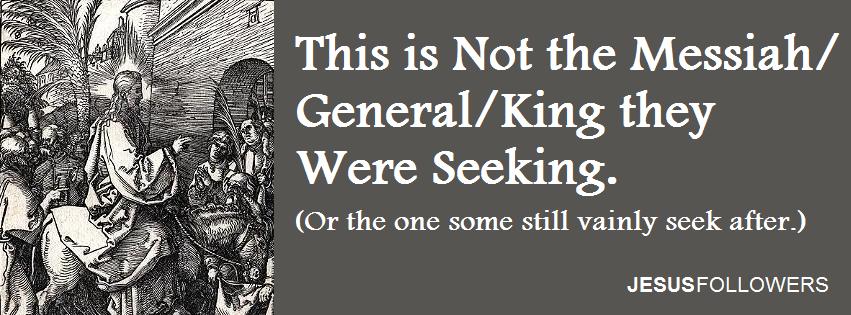
Welcoming the wrong Messiah - both then and now


As Jesus entered Jerusalem on that last week of his life, his disciples were joined by the many who had heard and seen him preach in Galilee and those who heard about his fame far beyond that region. And they rushed to welcome him.

Surely they had heard of his teachings and his works, and believed him to be the Messiah. And so he was. Today, we understand his Messiahship clearly when he said he was sent by God, Whom he called The Father, to rescue us from our sins and call us to repent and turn back to God. He proclaimed God’s Kingdom, and said it was both within us and among the people in the form of himself. And he called disciples to follow him in creating this Kingdom and spreading it throughout first Judea and then the earth.

But that wasn’t what many had in mind that day as they welcomed him and proclaimed him “King.” They sought a military leader, someone who would lead a military revolt and overthrow the Romans, re-establishing a literal kingdom of Israel, and bringing justice by the sword, not by words of peace.

And within days, almost all of them would be going home disappointed – saddened that THIS Messiah would not be leading a military revolt. They had somehow drastically misread the clear words of Jesus, and their failure to listen would have grave consequences for them and their nation.

Jesus was always very clear about his mission. He was clear that this Kingdom was to be brought into this earthly reality by our deeds and actions by following God’s Moral Commandments, and that we would all be judged by those deeds to be deemed worthy to enter in to Eternal Life.

His kingdom was “not of this world” and that which belonged to Caesar should be given to Caesar. Every opportunity he was given to sow sedition against Rome, he instead spoke of peace and individual repentance from individual sinful behavior. That’s not the preaching of a revolutionary, conquering Messiah.

Perhaps that’s why the Gospels portray even the Roman Prefect Pontius Pilate – who was otherwise known by historians as a brutal, ruthless ruler – as finding no sedition in him at all. Jesus is said to have answered Pilate, “My kingdom is not of this world. If my kingdom were of this world, my servants would have been fighting, so I would not be delivered over to the Jewish leaders. But my kingdom is not from the world.” This was a huge disappointment to those who sought a military revolt.

His entry into Jerusalem on a donkey, rather than on the massive white horse of a general, was also subtle hint about his true mission.

The key to understanding Jesus’ true mission (one of inaugurating a Heavenly Kingdom, not a military revolt) is that the religious leaders of the day hated him. They saw his teachings as a threat, and made numerous accusations against him, all of them false. They accused him of trying to end God’s Law (but he said he was upholding every line of it) and of trying to destroy the Sabbath observance (but he said he was upholding the true spirit of the Sabbath) and even trying to make himself equal with God (something he denied over and over again.)

And the day after his triumphal entry, he did something else that was unexpected: he entered the Temple, and there he loudly condemned those who were using it as a money-making venture, rather than a place of pure worship.

Today, Christendom – those who supposedly revere him and his teachings – continue to misunderstand him. They, like his contemporaries, believe him to be a conquering king who’s going to come back and smite all of his enemies – secular “Romans” – in a bloodbath.

Many arrogantly call themselves “children of the King” and believe that entitles them to riches in this earth, while Jesus taught we should never trust in riches, but instead store up riches in heaven by doing Good Works in this life (which today’s Christendom also condemns.) 

Most are quick to worship and admire him, and make his death and return to God into a magical charm that absolves them of the hard work of living in Righteousness as Jesus commanded us to do, rather than obeying his words and honoring his teachings. 

And many make God’s house into a money-making venture, rather than a pure house of worship.

So as we greet Jesus as he enters Jerusalem, let’s renounce those misunderstandings and look back to Jesus and his actual teachings. Let’s stop looking for a conquering General who will make our lives easier by simply killing our enemies and giving us all of Rome’s riches so we can live easily and in physical comfort in this life.

Let’s instead remember that we are greeting God’s chosen Prophet – the one who brings us a Good and Beneficial Message (“Gospel”) that tells us if we turn from our sins, we may live with God eternally, and live the Righteous life God wants us to live here on earth. 

Sunday, March 17, 2013

Can we obey God's Will?


Are we really able to obey God’s Will for our lives?

The scripture – God’s revelation to us – reveals His Will, and Jesus, God’s Anointed Prophet, makes it remarkably clear what is expected of us by God. And that all human beings have the ability to choose to obey God and the admonitions and teachings Jesus, or freely reject them, and reject God Himself, is amply attested to by all the Scriptures.

One such example: “I call heaven and earth to record this day against you, that I have set before you life and death, blessing and cursing: therefore choose life, that both you and your descendants may live.” (Deut. 30:19)

Now, one might say, “Isn’t the will of someone who has never heard of God’s Will for our lives weakened, and in some cases, depraved, by the constant habit of moral degeneracy?” Definitely. The wills of those who have sinned persistently have weakened by their own previous actions.

But even so, God’s holy Spirit enlightens us, and, through the clear teachings and ministry of Jesus, and those Followers who become the salt and light to the world, they are enlightened and awakened to God’s great Purpose for us – to live Righteously, and they may do so, relying on God’s Grace and the example of His Son.

The Gospel would not have set out so clearly the rules and precepts of virtue, piety, the excellent maxims of charity, humility, purity, temperance, integrity, honesty, and diligence in well-doing, if we didn’t have the ability to obey them – and the duty to do so.

The declarations of Jesus that no one shall enter into heaven who did not do not the will of his Father, and that God will render to everyone according to their works, would be meaningless – and unjust – if we were unable to obey, even after having been enlightened by God as to His Will, and strengthened by God’s fellow-workers.

Without the ability to obey God, the commands of His Son to have faith, to perform Good Works, or to even love and serve God by imitating him in all things, would be mere suggestions, and unworthy to be uttered by a Just God, and unworthy of our attention.

Without all of these Scriptural encouragements, the example of Jesus, and the ongoing help of God’s holy Spirit and the Light given by those who Follow Jesus, many to whom the Good and Beneficial Message Jesus preached would remain unreformed servants of sin.

But whose fault is that? If we are unable to obey, blaming some imaginary, hereditary sin-stain in our souls, then we throw up excuses at God, simply because we (as Jesus says) love darkness rather than light, and are really refusing to repent and Follow Jesus fully.

God provides us an Eternal Destination, and shows us a road that leads to it, and the means – which are like a car that is given to us to drive towards it. And He gives us gas in the car, and a key to start the car. And a precise map to that Destination. And co-pilots to encourage us along the way. 

We are told about the Destination, and the free gift of a car to take us there. We must get into the car, must start the car, and remain on the road. 

If we do, we reach the Destination. If we veer off the road, or fail to use the car, or don't accept the key, or stand next to the car, hoping that by simply thanking God for the car, or merely praising the gift, or praising the car, will get us to the Destination, we would have failed to reach the Destination, and we have deluded ourselves. And we would have no excuse for it.

I’m indebted to Rev. John Jortin for much of the wording and ideas in this sermon today. Thanks, John!

By the way, Rev. Jortin was an Anglican minister preaching in England in the mid-1700s. Clear and plain preaching on obedience has LONG been missing from pulpits, creating millions of lost, deluded christians.

Rev. Jortin’s preaching (like that of Jesus before him) rips away all excuses for disobeying God:

“To suppose men entirely passive, driven like mere machines to do good or to do evil by fatal, irresistible impulses, deprived of choice or liberty, and incapable of doing any thing, or taking any step towards amendment, to exaggerate the weakness and corruption of human nature contrary to the plain feelings and inward conviction of every rational agent, contrary to many clear expressions of scripture, contrary to the very use and design of admonition and exhortation; this surely is a strange method of bringing men to a sense and to a love of their duty. It is rather calculated to promote a false and presumptuous security, or a total dejection and despair, according as it operates on different temperaments. 
On the contrary, a persuasion that by God’s favor we can draw near to Him, if we will, is the only consideration that can excite us to exert ourselves in working out our salvation. Without this persuasion, there can be no hope, and without hope, there can be no endeavor. Let us then make it our choice and our occupation to serve God, and never plead want of power and of ability. Such thoughts are injurious to the Gospel, and to the Grace of God, Who will never be wanting to us while we are not wanting to ourselves.”

Amen. Let us therefore serve God by using our God-given moral ability to do so, using the free Gifts of His Grace that have been provided to us, following His chosen Son’s perfect example in all things.


Selected Scriptures:

"For this commandment that I command you today is not too hard for you, neither is it far off. It is not in heaven, that you should say, 'Who will ascend to heaven for us and bring it to us, that we may hear it and do it?' Neither is it beyond the sea, that you should say, 'Who will go over the sea for us and bring it to us, that we may hear it and do it?' But the word is very near you. It is in your mouth and in your heart, so that you can do it.” Deut. 30:7-14

“I call heaven and earth to record this day against you, that I have set before you life and death, blessing and cursing: therefore choose life, that both thou and thy seed may live.” Deut. 30:19

“And if it seem evil unto you to serve YHWH, choose you this day whom ye will serve; whether the gods which your fathers served that were on the other side of the flood, or the gods of the Amorites, in whose land ye dwell: but as for me and my house, we will serve YHWH.” Joshua 24:15

“And ye shall observe to do all the statutes and judgments which I set before you this day.” Deut. 11:32

"But those who do what is true come to the light in order that the light may show that what they did was in obedience to God." John 3:21

“Whoever believes in the Son has eternal life; whoever does not obey the Son shall not see life, but the wrath of God remains on him.” John 3:36

“If you love me, you will keep my commandments.” John 14:15 

"Whoever does not love me does not keep my words. And the word that you hear is not mine but the Father's who sent me." John 14:24

“Who is wise and understanding among you? By his good conduct let him show his works in the meekness of wisdom.” James 3:13

“By this we know that we love the children of God, when we love God and obey his commandments. For this is the love of God, that we keep his commandments. And his commandments are not burdensome.” 1 John 5:2-3