Sunday, April 16, 2023

The Pure, Simple Faith #Jesus Taught! #JesusFollowers


To promote real morality and true piety, we can conceive nothing so well fitted as the simplicity of Jesus - the plain, unequivocal, uninvolved requirement of love to God, tested by love to men and active usefulness in life. 

How utterly simple and plain, how free from all subtlety and dogmatic obscurity, is the teaching of Jesus.

His Sermon on the Mount is indisputable, practical, simple, having no abstruse, remote, or novel concepts. It proclaims no ideas that amaze or confuse, nor does it call for careful consideration on account of its novelty. It is a solemn, searching declaration of the universal religion of humanity. 

In it, he proclaims that God is holy, wise, good; blessed are you if you are pure, meek, hungering for righteousness, and living from the heart pure, useful, holy lives. This is all the doctrine there is in it ; not a word about the nature of the Godhead, the fall of man, the need of the atonement, the deity of Christ, the necessity of baptism and the saving sacrament of the  communion.  

Jesus was no scholar. He spoke the language and the truth and the religion of a simple, deep-thinking representative of universal humanity - true always, everywhere, and for all. There is nothing to add, nothing to take away, nothing to excuse or to explain away in his clear teachings. 

His teachings do not need any changes for the times, or the nation, or the circumstances, to account for them. It is because they give voice to what humanity knows and feels to be deepest and holiest, that they hold the allegiance of the Twenty-first, just as they will for those living of the Thirty-first Century. 

We cannot conceive of anything pertaining to our religious wants or our religious faith that do not already exist in the precepts, spirit, and example of Jesus.

We can very easily make the clear, simple, moral fact precisely what we choose to have it by enough twisted reasoning. And as we consider our consciences, so we are apt to consider our religion. God has pronounced it simple, plain, unmistakable. Jesus has taught and illustrated it in ways a child can understand. But it is so plain that it becomes severe; so simple that it looks cold and hard, like a marble statue.

We often hear the simplicity of Jesus as it reveals itself in the Sermon on the Mount compared disparagingly with the complicated faith of the Nicene Creed. But what can we call “the Christian religion” except that which really adds nothing to the old Jewish and the older natural religion of love to God and love to man, except the example and spirit of Jesus! 

What becomes of the Fall, and the Curse, and the Atonement, and the Sacraments, and the Trinity, and the Deity of Christ, and all the rest of the dogmatic paraphernalia of religion? They become invisible, like candles in the presence of the sun. 

It is the keeping of these great commandments that discloses their richness and fullness. They are simple, few, and concise. But live by them, and you will find that all the bodies of divinity in the world could not contain their lessons, or describe the glorious richness of their contents.

Do not allow yourselves to fall under the dominion of these high-sounding subtleties, these dark dogmas, these involved metaphysical puzzles, which pass for religion and Christianity. They will unsettle your common sense, and fog up your conscience, and finally make you think religion not the plainest thing in the world - a highway, in which the wayfaring man, though a fool, need not err, —but an enigma and a riddle, a sphinx which you must helplessly bow before and adore, though she will answer no question you put to her.

It is not the unknown we can profit by, but the known. It is not the obscure, but the plain, that should have our attention. It takes no learning, no scholarship, no formal logic, no fine-spun reasoning, to know God so far as we need to know Him, as a moral governor and Father of our spirits; to know Jesus as a holy, gentle, and wise master and guide of character; to know our duty well enough to live chastely, truthfully, honestly, with mercy and sympathy.

(Adapted from a sermon by Dr. Henry W. Bellows)

Sunday, April 9, 2023

Perfection: #Jesus' Most Misunderstood Teaching #JesusFollowers


"You must be perfect, as your Father in heaven is perfect." (Matt.  5:48) says Jesus. His life demonstrates the self-denial and sacrifice that leads to this moral perfection, and he calls us to follow his example.

And the Perfection of our Character is what he meant here. Jesus doesn't require us to be the fastest runner, the snappiest dresser, or be the most perfect orators in the world, with the best bodies. Perfection doesn't mean we all should seek to look alike, or that we must be able to do every mundane task perfectly, without mistakes. Nor is it something that happens immediatly.

These misunderstandings about what Perfection means is why some claim that we cannot "be perfect" in all things. And if these physical examples were the perfection Jesus demanded, all reasonable people could easily reject such a thing as impossible.

But how DO we achieve it?

Jesus simply asks us to daily seek Godly perfection in all we think, say, and do. Through service and self-sacrifice, we are perfected. This is the cross, the burden, Jesus bids us to take up in our daily journey.

Those who too quickly condemn the idea of obtaining moral perfection are therefore in conflict with Jesus' teachings, and deny that he spoke the truth during his ministry about our ability to follow him.

Jesus offers to us his lessons, his experiences, and his life as a perfect example of one who lived in perfect harmony with God, whom Jesus said was his and our Father. Jesus calls us to follow his example, doing exactly as he did, and to be perfect and holy, just as God is perfect and holy.

This Jesus, who said he was perfectly in accord with the Father, always doing what pleased Him (John 8:29) said that we could do all things that he did, and that if we loved him, we would do all that he taught us (John 14:21; 15:10) and would teach others to do the same. (Matt. 28:20)

The moral perfection of our character is the goal we are called to seek - growing into the people God wishes us to become. By taking up Jesus' challenge to seek perfection, we become part of God's Spiritual Kingdom Jesus established with his ministry of Good Works.

Jesus calls us to forgive, just as God forgives, and be merciful, just as God is merciful. Seeking to be Godly people is never labeled as "impossible" for us by Jesus. On the contrary, as a fully human man, just as we are, he demonstrated that God's commands are neither unreasonable, nor impossible.

Jesus calls us to fail more perfectly each time we try. Which, if we're humble about it, isn't "failure" anymore. We are called by Jesus to "Fail upward" on this journey towards this Godly perfection he calls us to.

Jesus calls us to serve one another, to love one another, and to fill our neighbors’ physical and spiritual needs – feeding, clothing, comforting one another –  just as we would want ourselves to be cared for. This the core of his teaching, and the core of God’s Kingdom.

By seeking to live according to the Will of God, as shown in the life, teachings and death of God's chosen spokesman, Jesus, we grow into the likeness of God, growing more perfect each day.

Jesus' challenging calls to be merciful and live lives of Moral Perfection teach us that we must avoid a lazy, easy religion, and instead seek to be better, more holy, joyful, and Spiritually Complete! (Luke 6:36, Matt. 5:48, John 15:11.)

So, let’s keep striving towards the Perfection Jesus modeled for us to live; a Godly ideal worth striving for!

Sunday, April 2, 2023

#Jesus: Fully and Completely Human, Like Us #JesusFollowers


What happens if Jesus was actually "just" a human being? What if Jesus was conceived and born exactly as we were, and was fully and completely human, just like us? The implications are startling for how we view our faith in God, and in a very good way.


Those who walked with him during his ministry knew very well that Jesus got hungry, got angry, got tired, slept, wept, bled, and prayed to God, just like they did. They knew him as a boy, they saw him gain knowledge, and grow from a baby into a man. In fact, this is the picture that manages to come through even in the Gospels as they have come down to us.

So, if this was the view of the earliest followers of Jesus, what happens when we, too, view Jesus as our elder brother - a fellow human being, fully and completely human, like us?

Something wonderful happens! With centuries of human inventions swept away, Jesus' teachings become fresh, alive and challenging, just as when he presented them the first time to astonished and joyful crowds.

With a completely human Jesus, the Gospel is a glorious set of challenges to accomplish. Jesus no longer preaches DOWN to us, knowing we cannot obey his lofty teachings that only a God-man can follow.

We must obey God’s moral Laws, and seek to follow Jesus in ALL of his teachings – because Jesus was able to follow God in all things, and said we could do all that he had done.

If we don't believe this is true, or think it's impossible, then we need to stop following him, because we are liars, not Jesus Followers. (1 John 2:4-6)

The Apostles said that God chose this fully and completely human Jesus (Acts 2:22) from among us human beings to be our example. And when Jesus said we may follow him, we know that we are able. As they say, "We can take that to the bank." 

As a "mere" human being, Jesus' teachings become something amazing. His full and complete humanity becomes our FULL pattern of life, because he followed all he tells us that God requires of us, and calls on us to do exactly the same. If we cannot do this, then Jesus was a liar when he says he did all God asked of him.

But he was just not lying, of course. His life and teachings show that he was honest about his relationship with God, and that this is the relationship we are ALSO meant to have with our Creator.

In short, the goals Jesus set for us only make sense if they are achievable BY us. And they are achievable only if he was fully and completely human, as we are.

When Jesus is viewed as fully and completely human, we accept as truth that God chose him from among humanity to be our example. And when he said we may follow him, we know that we are able.

God knows our spirit before we are born. He has always been fully aware of what we are capable, and in what ways we are weak. He didn't need to pretend to be human to do this. He is all-knowing, and all-seeing, and chose this perfectly obedient human being to be our example.

Jesus, who, as a man, was faithful to God in all things, assures us that we can do all that he did. (John 13:15; 14:12) Because Jesus followed God not with his lips alone but with his acts and with his heart, we need never fear acting as he did, letting our humble Works define our Faith.

When Jesus says "Take up your cross daily and follow me," he's calling us on a journey of joyful suffering and service, just as he embarked upon. 

But if we do not seek to follow his words, we are not really following Jesus. If we make excuses for not obeying his call to us, we are not worthy of his name. This fully and completely human Jesus is meant to be followed, not just admired.

“If you love me, keep my commands,” he says (John 14:15) But If we claim to know and love him, but reject his teachings, we are liars, unfit for his name. (1 John 2:4)

The fully human Jesus doesn't set impossible goals for the rest of us. If a human being just like us calls us to be perfect, "just as your Father in Heaven is perfect" (Matt. 5:48) and he, himself achieved it, then that is a challenge worthy of human beings.

We lose our excuses for sinning with a fully, completely human Jesus. We can no longer say we are "only human," hiding behind our alleged inherited moral sinfulness, if Jesus, too, was born as we were, and yet found favor with God. We can no longer hide behind our alleged human frailty, we cannot blame others or our supposed genetic inability, and we can't say that sinning is our "nature," if Jesus shared that nature with us, fully and completely.

Sunday, March 26, 2023

Simple Christianity: As Jesus Taught It #JesusFollowers

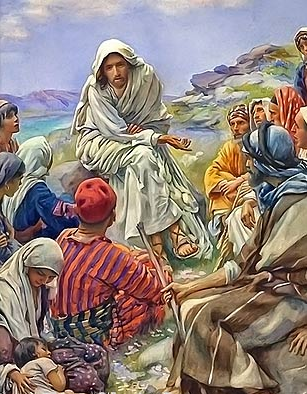
 Jesus teaching

“Lord, to whom shall we go? You have the words of eternal life." - John 6:38.

Who will show us any good? Where are we to look for the clearest, truest setting forth of his religion? 

There is such a variety of Churches, there are such differences of form and of creed, there is such a confusion of ecclesiastical tongues, and so many of them asserting that theirs is the only faith by which anyone can be saved.

And meanwhile, some think it doubtful if any faith can stand. Where shall we find some real light - some solid ground to rest upon?

Am I mistaken in saying that this is a craving widely felt at the present time?

The heart of society just now is in a curiously puzzled and perplexed condition. It is not satisfied. People have the answers of their various Churches. 

These tell them in creed and catechism, in article and confession, what it is that man must believe, and which shall be "saving faith” to him. 

And all the points are well backed up by “proof texts,” which sound clear and unmistakable; yet, when all is said, people are not satisfied.

It may not be that they have come to actually disbelieve these doctrines, but they do not feel that they go to the root of the matter.

Now I want to set before you what I believe to be the true way out of these doubts, the true way to this broader, simpler, more practical religion.

That way, I believe to be, to look simply to Christianity as Christ Jesus preached it; to go back, as near as we can, through the narratives of the Gospels, to Jesus as he went about among the people, himself preaching his own “good tidings" - his own religion. 

See what he himself said. how he answered people's questions; what he urged them to believe or to do, his beautiful, deep sayings. 

These an old saying: “The Bible, and the Bible only."  Well, I want to bring that idea to a brighter point still: “Jesus, and Jesus only, the special teacher for Christians.”

There is not a church throughout the world that does not claim Jesus as its teacher. The real difficulty occurs when we come to the practical application of it. 

Those four Gospel accounts of how he himself preached are sufficient in giving us Christianity as Jesus himself preached it.

A great deal of what passes for Christianity in the churches of the day will fail when tried by this test.

Always Jesus represents God as only wanting our repentance, waiting to forgive. There is never a word about the necessity of the penalty being paid; never a hint as to there being any hindrance to God's free mercy, except the hindrance of a hardness of heart.

I want to set before you the simple Gospel which Jesus Christ went about trying to persuade people to receive - the Gospel of love and practical righteousness.

Surely the very heart of it all, that which was the central light, was his sense of the infinite tenderness of God, and of the blessedness of living in His love, as His trustful and faithful children. 

Just let us recall the manner of our Savior's ministry, how he went about, what he taught the people:

Blessings on the pure in heart, the meek, the merciful, the peacemakers, exhortations to a higher righteousness than that of the Law as set forth by the Scribes and Pharisees; teachings about brotherly love – “leave your gift before the altar, and go and make up with your brother;" not doing anything “to be seen by others;" about the quiet charity that should not let the left hand know what the right hand does; about patience, and kindness - enforced by reminding them of God's kindness to all of us.

And the passage, "Not everyone that says to me Lord, Lord, shall enter into the kingdom of Heaven, but he that does the will of my Father in Heaven."

That sermon was what one may call the great proclamation of his ministry. Then, follow him in thought as he moves among the people, telling them of the priceless value of having the kingdom of God in their hearts. 

And always he turns around from these thoughts of the Heavenly Father's love, to appeals for our loving duty! God's part was free, unpurchased love; our part He says is practical righteousness.

Never from his teachings could that false idea of righteousness be learned, which places opinions above conduct.

And it was not his teachings alone. These teachings were uttered in something nobler than word. The teaching was done into life.

And the Life was more powerful than the word, and so it is not merely “Christianity as Jesus preached it,” but “as Jesus lived it,” that stands for us in the Gospels.

The more I look upon that life of such sublime strength, holy love, and deep, living wisdom, the more I think of what Christianity was as Jesus preached it, and the more I feel how poor our faith in Him has become.

Place first a faith in those grand, simple teachings of God's love and our duty, and hold them up before the world with all the power of your speech and of your life.

(Adapted from an 1875 sermon by Rev. Brooke Herford 1830-1903)

Sunday, March 19, 2023

#Jesus: Anointed By God And Sent Out To Preach #JesusFollowers


Jesus came into, and went out into, "the world," when, leaving the country around the Jordan River, he returned to Capernaum after the imprisonment of John, and began to teach in the synagogues and preach, saying, "Repent, for the Kingdom of Heaven is at hand."

In general it is to be observed, that "to come into the world," do not ordinarily, if ever, in the language of the New Testament, signify to be born, but publicly to assume the character of a divinely-appointed teacher: and "to be sent" signifies to be invested by God with this position, and to be begin an active mission to support it. 

When this public mission came upon him, he says, "I came not of my own accord, but He [God] sent me." (John 8:42) And says, "The Son of man came not to be served, but to serve." (Matt. 20:28) These words cannot either with propriety or truth be referred to his entrance into life, for he did come at birth to serve others, and did not anoint himself to this mission, and certainly not as a baby.

Here he is proposing an example to his disciples, and appeals to the knowledge they had of his conduct among them, from his first entrance on his ministry at the age of 30.

He did not make disciples for his own sake, but for theirs; he came not out into towns of Judea to be served by them, but to serve them, and was hereafter to carry his services so far, as even to lay down his life in their behalf.

Jesus, speaking of himself, says, "him whom the Father has consecrated and sent into the world." (John 10:36) He was first consecrated, when "God anointed Jesus of Nazareth," says Peter, "with the holy Spirit and with power," to go about doing good. (Acts 10:38)

At the baptism of Jesus, God was heard to say of Jesus, "you are my Beloved son, in whom I am well pleased." (Luke 3:22) And an old reading of this same verse reads, "You are my son, today I have begotten you [become your father]," echoing Psalm 2:7 (and Hebrews 1:5) Both versions testify to his anointing for his mission at his baptism.

Thus this man was set apart, consecrated to his office, and qualified to discharge it, and then was commissioned to go out into the world to execute this mission. According to our Master's own words, he "came into the world" only after his baptism, at which God's holy Spirit descended upon him, and not before.

Jesus, addressing himself to God, and speaking of his disciples, says, "As you have sent me into the world, even so have I also sent them into the world." What is it that he here says of his disciples? How was it that he sent them into the world? 

After they had been fully instructed in things about to the kingdom of God, he sent them out unto all nations to preach to others the doctrine he had delivered to them.

When he says of himself, therefore, that God "sent him into the world," since he was sent by the Father, as they were sent by him, he speaks of the authority with which he was invested, of the command that had been given him to publish to the world the doctrine which he had himself received from the Father.

The spirit was not poured out on Jesus, he was not in vested with divine authority and power, thus qualified to execute the will of God and sent out into the world, to take vengeance on them for their sins; but to impart to them, at the expense of all worldly comforts, and, in the end, of life itself, the most consolatory and the most salutary doctrine, the belief and the obedience of which will entitle them unto eternal life.

Is it an advantage that such a great example should was held up to our imitation? Definitely. Would not any person, who aspires to perfect virtue, wish that a perfect model of it should be placed before them, to illustrate and recommend its maxims and its precepts, to guide and to encourage, to animate desires, to invigorate endeavors, and to excite emulation?

This advantage is enjoyed by us far more perfectly than could have been if our Master had not gone out into the world; for by this means his virtues are rendered more conspicuous, they are seen by us in a greater variety of lights, proved by a greater variety of difficulties and temptations, and his example is made applicable to a greater variety of circumstances and conditions.

We see what, if he had continued in obscurity, we could not have seen in him that our duty is in every instance practicable; that virtue is in every condition possible, and abounds with such comforts as can make any circumstances tolerable.

By this means we have the instructions, and encouragements, and incitements, that are contained in his example, who was in all points tempted as we are, and yet was without sin. We may be pure in heart, we may be holy in all manner of conversation; we may have the same mind that was in Jesus; we may walk as he also walked; we may be like God, and acceptable to him; ever growing in his likeness and his friendship. To what dignity, to what comforts of the Gospel of Jesus may we achieve! How good is God! How great a gift is Jesus!

(Adapted from the works of Newcombe Cappe, 1733-1800)

Sunday, March 12, 2023

God Is Not Our Wish-Granting Genie


If a stranger walked up to you on the street and said, "I know a guy, a professional 'fixer,' who can get you a better job, make sure you get more money, attract a perfect mate, and even manipulate other people to make things, you know, go BETTER for you," you'd probably think he, like TV's Tony Soprano, was inviting you to join a criminal enterprise.

But shockingly, people - many, many people - believe this about GOD, the Creator of the universe! Many, in fact, believe He is in the same "business" as Tony Soprano - the business of manipulating the world to "fix" things for those He randomly selects to be in his "family."

Many people actually PREFER this view of God because it means we can throw the burden of "Good Works" onto God Himself, and selfishly (albeit PRIVATELY) complain when God doesn't work all things out for our personal, selfish benefit.

But that paints God as a sky-dwelling puppet-master - a magic genie who manipulates every detail of every human life.

This may be a very ancient view (ancient paganism) but it's a completely FALSE, childish, and warped view of God, our world, and of the faith God wishes for us.

How shameful it is for us to believe that God, our Creator, can manipulate people we dislike or who aren't on our "team" to lose their jobs, to have car accidents, to be injured, or to get diseases!

And how sad to believe that WE should somehow be immune from trouble because God is our "fixer in the Heavens." Again, this is an appeal to paganism and magic, not to Jesus and his, and our, God.

This Jesus, the one God selected to tell us about God and what God requires of us, tells us that we are to conform our lives to God's Will and to seek always His perfect purity, holiness and goodness by faithful obedience. 

By doing this, we will be equipped to handle whatever happens to us during our daily journey. 

Jesus never tells us we will never be persecuted, hated or despised for doing this. In fact, Jesus says: be READY for it. This is what we sign up for as Jesus Followers, not golden streets, great wealth and perfect health.

In reality, Jesus calls us to a healthy, adult relationship with our Father, and wishes us to treat all people as our brothers and sisters, loving them, and Him, with all that we have. 

Jesus calls us to take action OURSELVES to build up God's Kingdom, through righteous acts and purified motives.

But doesn't God "move mountains?" Doesn't He work miracles, and grant us Grace to achieve what He asks of us?

Surely, God does indeed "move mountains" - by granting us ever growing faith by which we can COMPLETELY change our lives into something resembling the one His chosen Spokesman, Jesus, modeled for us during his life, and even in his death.

God changes lives in miraculous ways - when our eyes are finally open and we see the wonderful spiritual principles His servant Jesus laid out for us, which will help us achieve the kind of perfection God calls us to achieve.

And God never leaves us alone, sending us His Grace when we ask for strength through prayer. And we know that we have Jesus' example and words always with us as a guidepost, showing us how we are to live according to God's Will.

We must lay aside the ignorant and pagan beliefs we have inherited from the childhood of the human race.

God is not a sky-dwelling Genie who will grant our material wishes and make us rich or healthy; and when we instead seek a simple, profound and straight-forward faith in which we obey God through the example of His Anointed one, Jesus, we enter into a healthy, joyous and adult relationship with our Father.

Sunday, March 5, 2023

#Jesus Is Our Perfect Example! #JesusFollowers

The life, teachings and death of Jesus inspire us to follow Jesus' example.

Jesus had the fullness of his Father’s spirit; and we have also a portion of the same. This puts all the children of men on equal ground, and makes Jesus our Pattern.

His example becomes the point after which we are to aspire; for his righteousness must be the criterion of judgment; and because he arrived at perfect obedience, doing in all things that for which he was sent by his Father, Jesus has shown by his example that all are able to obey God.

Jesus was a perfect example to us, to show to us that for the testimony of God our creator, we must be willing, as Jesus was, to surrender up everything unto God; and to do his will in everything, even if it cost us our natural lives. For if we are brought into the situation that he was in, that we cannot save our natural lives without giving up the testimony that God has called us to bear, we have his example not to do it, though we may feel as he did, that it is a great trial.

We have it now on record. We need only take up the precepts of Jesus, only look at his example, and his direction to his disciples, and see if we can find anything, any testimony worthy to be compared with it.

What is true religion? It consists entirely in righteousness, that righteousness which is acceptable in the sight of God. It unites us with God, as it did his blessed Son, and brings us to partake of his holy nature, and we become one with him – as the disciples formerly were declared to be partakers of the divine nature.

Until we do everything in our power, by every means put in our hands, we shall not find support from God! There are no sins so great, in this probationary, earthly state, our Father would not stand ready to forgive, if we turn to Him with full purpose of heart and acknowledge our transgressions.

He gives us the grace of repentance, and enables us so to walk as to be reconciled to Him, and gain a greater establishment in Himself, and in the truth, than when we first came out of His creating hands.

(Adapted from an 1826 sermon by Elias Hicks)